Historic Circular Route Achenbach


- 3:25 h
- 12.02 km
- 305 m
- 305 m
- 266 m
- 429 m
- 163 m
- Start: Hiking panel at the entrance to Achenbach
- Destination: Hiking panel at the entrance to Achenbach
The Historic Circular Route Achenbach is the first hiking route in Germany to be awarded the designation 'Quality Route Wanderbares Deutschland – Cultural Experience'. In 2022, the twelve-kilometer route was named 'Quality Route Wanderbares Deutschland – Dream Route' by the German Hiking Association. The route, which leads through a beautiful and varied landscape, features over 40 stations. Information panels help to properly contextualize the history from the La Tène period to modern times.
This themed hike uniquely combines impressive natural spectacles, cultural highlights, and modern leisure offerings. Along this route, you will encounter orchids and bubbling springs, as well as an impressive blast furnace model and settlement traces from pre-Christian times, memorial sites, and a wooden church.

Waypoints
Good to know
Best to visit
- suitableDepends on weather
Directions
Along the historic themed circular route, information panels provide insight into this path and the defining combination of landscape experience and regional cultural history. We begin the hike at the memorial site of the former Belgian garrison, directly opposite the Edeka market. From there, we follow Achenbacher Street (away from the roundabout) until a turn-off appears on the right. We follow this small street and arrive at the Friedenskirche, which is a listed monument.
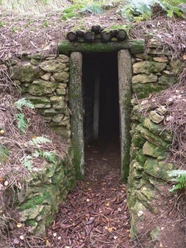
Next, we continue past the Friedenskirche and come to a blast furnace model. An information panel along the path explains the smelting furnaces from the La Tène period in the Engsbach valley. Around 1933/34, about 40 iron smelting furnaces were uncovered here. The best-preserved one was recovered and now stands in the Siegerland Museum in the Upper Castle in Siegen. A model of the blast furnace found there is on display here and shows how advanced the Celts were at that time.
From here, the Historic Circular Route passes the source area of the Engsbach with its variety of orchids. The Engsbach valley was registered as an archaeological monument in 2015. Around forty blast furnaces from the 3rd and 4th centuries BC once stood here. The best-preserved blast furnace was salvaged and is now also in the Siegerland Museum in the Upper Castle in Siegen. We continue uphill, at the large intersection at the top we keep left, then take the next right turn. We pass a light woodland and stand before the information panel for the park-like experiential area SCHÖNUNDGUT. A detour to the former shooting range, which today offers so much for children and young people, is fun. Benches and picnic areas invite you to take a break.
Refreshed, we continue along the marked path at the forest edge downhill, taking the descending trail down into the enchanting Numbach valley nature reserve, right along the Numbach, which is fed by many springs and small brooks and flows quietly in its natural bed. An oasis of tranquility. The Numbach valley is considered one of the most beautiful valleys in the Siegen area. We accompany the softly babbling brook through quiet nature into the valley.
Only 250 meters away, the SELK church appears. It is the only church community in Siegerland that consciously adheres to the teachings of Martin Luther. The history of the St. Christopher's community in Siegen is based on the arrival of Lutheran Christians at the beginning of the 1920s. Past a wooden carved fox figure, ant colonies, and the "Alte Brandzeche" pit, the hiking trail leads to a breathtaking viewpoint.
Next, we proceed up to the Buberg and then over the Starken Buberg, which at 439 meters is the highest point on the route. Here, the landscape has changed completely due to massive tree felling.
A little further on, the circular route touches the parallel routes of the European long-distance path E1, the Elisabeth path, and the Way of St. James.
Our route continues past the Achenbach spring and the Langenseifen spring with the biotope in between. Then another highlight of the route unfolds, as the path leads through the landscape of three Hauberg cooperatives: Achenbach, Trupbach, and Seelbach. Here, a panel informs about the Hauberg system in Siegerland, which is also listed as intangible UNESCO World Cultural Heritage.
Past a religious image column and the Großenbach spring, the path now leads to the viewing platform.
Our gaze sweeps to the town center where we see the local history house and the old school. The viewpoint invites visitors to sit down and linger a while.
After a short rest, we continue past a well and to the old school. A detour to the village pond with picnic areas is worthwhile. The old school was built in 1930 as a replacement for the first Achenbach school (chapel school from 1861). In 2014, the building was listed as a monument. Its architectural style is based on small town town halls in northern Hesse from the 17th and 18th centuries, whose harmonious proportions were taken up with care and consideration. The old school is the only listed school building in Westphalia-Lippe built in this style.
Another highlight follows directly, namely the local history house and the heritage room. Built around 1860 as the residence of entrepreneur Johannes Spies, the house was taken over in 1927 by the school association of the municipality of Achenbach and converted into a meeting place for local history enthusiasts. In June 2018, a small local museum was opened here. Visits are possible by appointment.
The circular route continues through a natural path through the meadow valley. Native shrubs such as elder, blackthorn, blackberries, and raspberries grow here. A small orchard, wild meadows, as well as four walnut trees and old beech, birch and oak trees line the path. Several benches invite relaxation and lingering in this natural oasis. The Achenbach, the namesake, flows through the entire valley and gives the meadow path its own flair.
Above the meadow valley towers the stilt house “Skycube”. It stands on steel stilts and is cube-shaped.
Shortly before the end of the circular route, in the Achenbach ford, the "Victory Oak" planted in 1871 takes center stage. The ford also forms a second settlement focus of the village of Achenbach.
The path finally leads us back to the starting point of the circular route.
Tour information
Cultural Interesting
Loop Road
Stop at an Inn
Directions & Parking facilities
- Getting there
A45 Siegen junction, B62 towards Siegen, then left past Ikea to the edge of town (Wallhausenstr.). In the roundabout take the 3rd exit to the Edeka car park
ParkingCar park at Neukauf in Achenbach. Author
Katja Teixeira
Organization
Touristikverband Siegen-Wittgenstein e.V.
License (master data)

Author´s Tip / Recommendation of the author
There is much to discover: be sure to plan enough time for the various sights along the route!
Nearby




Download GPX file